
Ramses II: The Greatest Pharaoh of Ancient Egypt
Ramses II, often referred to as Ramses the Great, is one of the most iconic figures in ancient Egyptian history. His reign, which spanned 66 years from 1279 BC to 1213 BC, was marked by extraordinary accomplishments in military strategy, diplomacy, architecture, and governance. As the third pharaoh of the 19th Dynasty, Ramses II not only secured Egypt’s borders and expanded its territory but also left behind a legacy that continues to captivate historians, archaeologists, and the general public to this day.
Early Life and Rise to Power
When was Ramses II born? Born in 1303 BC, Ramses II was the son of Pharaoh Seti I and Queen Tuya. His birth marked the continuation of a lineage that had been elevated to royalty just a generation earlier by his grandfather, Ramses I, a military commander who had risen to the throne due to his prowess and loyalty to his predecessor, Horemheb. Ramses II was named after his grandfather, a gesture that not only honored the family’s origins but also signified the continuity of its rising power.
Ramses was raised in the royal court, where he received a comprehensive education in the arts of war, governance, and religion. His father, Seti I, who was a formidable military leader himself, involved Ramses in state affairs and military campaigns from a young age. By the time Ramses was a teenager, he was already leading armies into battle alongside his father, gaining invaluable experience in the field. This early exposure to the complexities of leadership and warfare set the stage for Ramses to become one of Egypt’s most successful pharaohs.
At the age of 14, Ramses was appointed as the Prince Regent, a position that effectively made him the heir apparent to the throne. His older brother had died prematurely, leaving Ramses as the only viable successor. As Prince Regent, Ramses had a direct hand in many of the decisions that shaped the kingdom, and he quickly became known for his strong leadership and strategic mind.

Ascension to the Throne and Early Reign
In 1279 BC, following the death of Seti I, Ramses II ascended to the throne at the age of 25. His coronation marked the beginning of what would become one of the longest and most prosperous reigns in Egyptian history. One of Ramses’ first acts as pharaoh was to consolidate his power by strengthening his military forces and initiating a series of campaigns aimed at securing Egypt’s borders and reclaiming lost territories.
Ramses’ military strategy was characterized by his ability to adapt and respond to changing circumstances on the battlefield. He was known for his hands-on approach, often leading his troops personally into battle. This not only inspired loyalty among his soldiers but also allowed him to make quick, decisive actions that turned the tide in Egypt’s favor on numerous occasions.
The Battle of Kadesh
One of the most famous military engagements of Ramses’ reign was the Battle of Kadesh, fought in 1274 BC against the Hittite Empire. The battle, which took place near the modern-day Syrian-Lebanese border, was one of the largest chariot battles ever recorded in history. The stakes were high, as both Egypt and the Hittites were vying for control over the region of Canaan, a strategically important area that had been under Egyptian influence for centuries.
The Hittites, led by King Muwatalli II, had assembled a massive force of 50,000 troops, including 3,500 chariots. In contrast, Ramses led a smaller Egyptian force of about 20,000 men. Despite being heavily outnumbered, Ramses demonstrated remarkable courage and tactical skill. The battle itself was a chaotic and brutal affair, with both sides suffering heavy casualties.
At a critical moment, Ramses found himself isolated from the main Egyptian force, surrounded by Hittite chariots. In what has become one of the most celebrated episodes of his reign, Ramses personally led a counterattack with his remaining troops, breaking through the Hittite lines and rallying his army. Although the battle ended in a stalemate, with neither side claiming a decisive victory, Ramses’ actions solidified his reputation as a fearless warrior and a capable leader.
The Battle of Kadesh was later immortalized in Egyptian art and literature, with Ramses depicted as a heroic figure who single-handedly turned the tide of battle. These depictions, though undoubtedly exaggerated, served to bolster Ramses’ image as a divine ruler, chosen by the gods to lead Egypt to glory.

Diplomatic Triumphs: The First Peace Treaty
While the Battle of Kadesh did not result in a clear victory for either side, it did lead to one of Ramses’ most enduring accomplishments: the signing of the first known peace treaty in history. After several years of intermittent conflict, both Egypt and the Hittites recognized that continued warfare would only lead to further devastation. In 1258 BC, Ramses and Hittite King Hattusili III negotiated a peace treaty that established a lasting truce between the two empires.
The treaty, inscribed on a silver tablet and preserved in both Egyptian and Hittite records, was remarkable for its time. It included provisions for mutual defense, the extradition of fugitives, and the return of each other’s subjects. The treaty also formalized the borders between the two empires, ensuring a period of stability that allowed both regions to prosper.
The peace treaty with the Hittites is often cited as one of Ramses’ greatest diplomatic achievements. It not only secured Egypt’s northern border but also established Ramses as a ruler who could balance military might with statesmanship. The treaty was so significant that copies of it were displayed in temples throughout Egypt, and a replica of the treaty now hangs in the United Nations Headquarters in New York as a symbol of early diplomacy.

Architectural Legacy
Ramses II is perhaps best known for his monumental building projects, which were unrivaled in scale and ambition. His reign was marked by a flurry of construction activity, as he sought to leave a lasting legacy through the creation of grand temples, statues, and cities. These projects not only demonstrated Egypt’s wealth and power but also served to glorify Ramses himself as a living god.
One of the most iconic architectural achievements of Ramses’ reign is the construction of the temples at Abu Simbel. Located in Nubia, near the southern border of Egypt, the Abu Simbel temples were carved directly into a mountainside and are dominated by four colossal statues of Ramses, each standing over 20 meters tall. The temples were designed to impress and intimidate, serving as a testament to Ramses’ power and divine status. The larger temple was dedicated to the gods Amun, Ra-Horakhty, and Ptah, while the smaller temple was dedicated to Ramses’ beloved wife, Queen Nefertari, and the goddess Hathor.
The Ramesseum, another of Ramses’ monumental projects, was his mortuary temple located on the west bank of the Nile near Luxor. The Ramesseum was not only a place of worship but also a symbol of Ramses’ eternal legacy. The temple complex was adorned with statues, reliefs, and inscriptions that celebrated Ramses’ military victories, particularly the Battle of Kadesh. The Ramesseum was intended to ensure that Ramses would be remembered and revered long after his death.
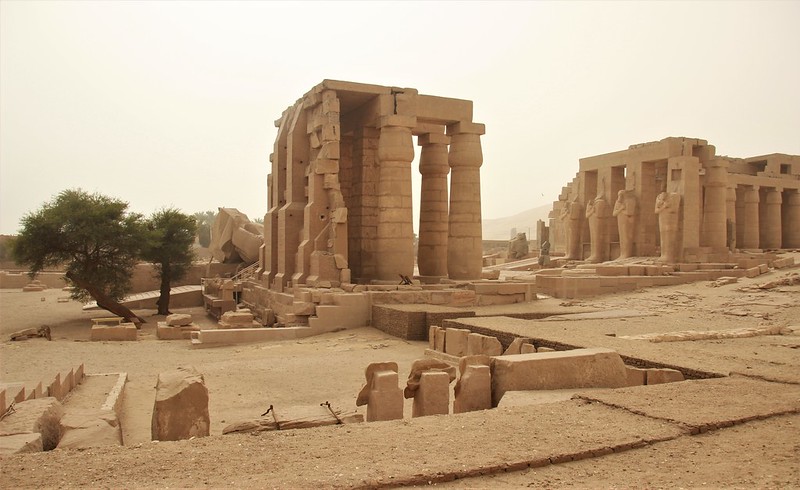
In addition to these grand temples, Ramses also oversaw the construction of Pi-Ramesses, a new capital city located in the Nile Delta. Pi-Ramesses, which means “House of Ramses,” was a sprawling metropolis featuring vast palaces, temples, and gardens. The city served as both a political and military center, strategically located to facilitate campaigns in the northern territories. Pi-Ramesses became one of the most important cities in Egypt during Ramses’ reign and remained a major center of power for centuries.
Ramses’ architectural contributions extended to existing structures as well. He commissioned extensive renovations and additions to the temple complexes at Karnak and Luxor, both of which were already significant religious sites. At Karnak, Ramses added a grand hypostyle hall, featuring 134 massive columns, each decorated with intricate carvings and inscriptions. At Luxor, he erected towering statues of himself and added detailed reliefs that depicted his military triumphs. These enhancements not only reinforced Ramses’ divine status but also ensured that his name would be forever associated with Egypt’s most sacred places.
Ramses II Family and Personal Life
Ramses II was not only a great ruler but also a family man, known for his numerous wives and children. How many wives did Ramses II have? He is believed to have fathered more than 162 children, a record that places him among the most prolific rulers in history. His first and most beloved wife was Queen Nefertari, who held the title of “Great Royal Wife.” Nefertari was not only Ramses’ companion but also a powerful figure in her own right, playing a significant role in both religious and political affairs.
Nefertari’s influence is evident in the grandeur of her tomb in the Valley of the Queens, which is one of the most beautifully decorated tombs in Egypt. The tomb’s walls are adorned with vivid paintings depicting Nefertari’s journey to the afterlife, guided by the gods. The care and attention given to her tomb reflect Ramses’ deep affection and respect for her.

In addition to Nefertari, Ramses had several other wives, including Isetnofret, who was the mother of his successor, Merneptah. Ramses’ children held important positions within the kingdom, often serving as priests, military commanders, or administrators. His sons were groomed for leadership roles, while his daughters frequently held religious titles, further solidifying the importance of the Ramses II family in both the royal court and religious institutions of ancient Egypt.
Despite his numerous children, Ramses II outlived many of them. His immediate successor was not his firstborn but his third son, Merneptah, who assumed the throne after Ramses’ death. Merneptah’s ascension was a testament to Ramses’ careful planning and the stability of his dynasty.
How Did Ramses II Die? When and Where?
How did Ramses II die? Ramses II lived an extraordinarily long life by ancient standards, reaching the age of 90 before his death in 1213 BC. He is believed to have died of arthritis, a condition that had likely afflicted him in his later years. His longevity and prolonged reign allowed him to leave behind a remarkable legacy, both in terms of his achievements and the monuments he constructed.
Initially, Ramses II was buried in the Valley of the Kings, in the tomb designated KV7. His tomb, like many others in the valley, was carefully crafted to ensure a secure resting place for the pharaoh’s remains. However, to protect his mummy from grave robbers, Ramses’ remains were later moved to a hidden cache in Deir el-Bahri. In 1881, the mummy was rediscovered and subsequently placed in the Egyptian Museum in Cairo, where it remains today.
Ramses II and Moses: Historical Accuracy
It is important to note that Ramses II and Moses are not directly connected in historical records. The idea that Ramses II was the Pharaoh of the Exodus, or that he died in the Red Sea, is a misconception with no historical basis. There is no direct evidence linking Ramses II to biblical history or the Exodus narrative.
Ramses II Mummy and Legacy
Ramses II mummy was extensively studied in the 20th century, providing insights into his physical appearance and health. The studies revealed that he had sharp features, a strong jawline, and a tall, muscular physique. His legacy as the “Great Ancestor” and his impact on Egyptian culture continue to be celebrated and studied, ensuring that his contributions to history are remembered for generations to come.

Ramses II’s monumental achievements and the awe-inspiring structures he commissioned stand as enduring symbols of his power and vision. His contributions to architecture, military strategy, and diplomacy have cemented his status as one of ancient Egypt’s most revered pharaohs.

Comments