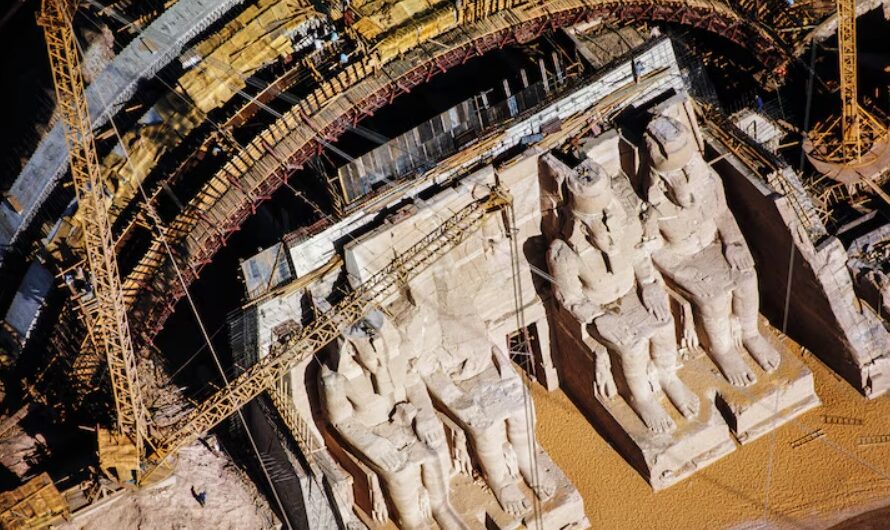
I met a traveler from an antique land Who said: Two vast and trunkless legs of stone Stand in the desert. Near them, on the sand, Half sunk, a shattered visage lies, whose frown, And wrinkled lip, and sneer of cold command, Tell that its sculptor well those passions read Which yet survive, stamped on these lifeless things, The hand that mocked them and the heart that fed. And on the pedestal these words appear: "My name is Ozymandias, king of kings: Look on my works, ye Mighty, and despair!" Nothing beside remains. Round the decay Of that colossal wreck, boundless and bare The lone and level sands stretch far away. This tale, immortalized in Percy Shelley's poem "Ozymandias," served as a prelude to a larger saga of exploration and rediscovery. It was a saga that unfolded in the early 19th century, amidst the backdrop of European fascination with the treasures of ancient Egypt. The first scientific foray into documenting Egyptian monuments came with the French campaign led by Napoleon in 1797. The results of this endeavor were the renowned ten volumes of "Description of Egypt," which cataloged and researched almost every aspect of the country, except for the remote reaches of Nubia, where Abu Simbel lay buried beneath the sands. It wasn't until March of 1813 that a Swiss traveler, Johann Ludwig Burckhardt, known locally as Sheik Ibrahim for his fluent Arabic and traditional attire, stumbled upon the buried temples of Abu Simbel. The temples, engulfed by centuries of desert sands, presented an enigmatic puzzle to Burckhardt, who couldn't discern whether the monumental statues at the entrance were standing or sitting. His return to Cairo ignited curiosity and interest in Abu Simbel, eventually capturing the attention of Henry Salt, the first British Consul in Egypt. Salt, driven by
I met a traveler from an antique land Who said: Two vast and trunkless